Debugging a Silently Failing Escalation Workflow
silent Jira escalation failures → 2 hypotheses eliminated → payload root cause → workflow validated and hardened
The Problem
During the phased rollout of FLiiP's HubSpot-to-Intercom migration, some support escalations silently stopped creating Jira tickets. The automation appeared to fire, only some escalations failed, and nothing reported the failures.
My Investigation
I owned the investigation end to end: reproducing the failure, comparing successful and failed escalations, rollback testing, and payload inspection. Two hypotheses were eliminated before the cause turned up in the JSON sent to Jira.
Root Cause
Required attributes could arrive empty or missing, and fields could mismatch the Jira schema. Either condition made Jira reject the entire request, silently.
Result
The fix made failures surface instead of hide: mandatory attributes, field alignment, validation before escalation, and error handling that put failures where the team was already looking. The lasting change was observability, not just repair. Once developers could trust the workflow, the integration was expanded with additional attributes.
Context
This happened inside the story another case study on this site tells at full length: the HubSpot-to-Intercom migration, during its roughly two-week phased rollout in early July 2026. That piece is about keeping the support channel alive through a platform change. This one is about a single failure inside that window, the kind that doesn’t announce itself, and the investigation that found it.
Part of the migration’s redesign was automatic escalation: support issues that needed engineering created Jira tickets directly from Intercom, with context attached. Developers’ visibility into support work depended on that handoff working. My role covered the support side of the migration, including the escalation workflow’s design. So when the handoff broke, the investigation was mine.
Symptom
After recent workflow modifications, some escalations stopped creating Jira tickets. Three properties made it the worst kind of failure to see:
- It was silent. The automation appeared to trigger successfully; nothing errored where anyone was looking.
- It was partial. Most escalations still worked, so the workflow looked healthy at a glance.
- It looked like success. From the support side, an escalated conversation seemed handled. The ticket that should have existed simply never did, somewhere nobody could see.
Stakes
The support channel showed no known interruption. Customers’ conversations continued normally, as far as the rollout monitoring could tell, which is the same carefully bounded claim the migration case study makes. What broke was a different channel: the handoff from support to engineering. When an escalation silently failed, the customer’s conversation looked fine. What vanished was invisible to them: the ticket that should have reached a developer. That is where the cost lived: SLA exposure on the escalation path, reduced engineering visibility, and the risk of delayed investigation and duplicate customer contacts as issues stalled unseen.
Investigation
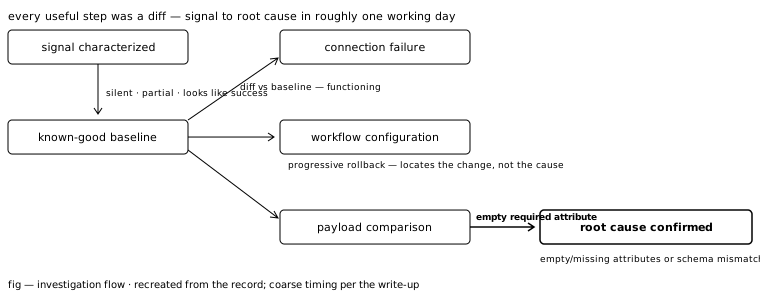
Signal to confirmed root cause took roughly one working day. The record, reconstructed with deliberately coarse timing:
- 01Signal characterized
Escalations from Intercom intermittently produce no Jira ticket, while the automation appears to trigger successfully.
- 02Baseline established
Reproduced the failure and gathered known-good cases. Previous successful escalations became the comparison baseline.
- 03Hypotheses testedHypothesis ARuled out
Connection failureEvidenceCompared against the successful escalations: the Intercom–Jira connection itself was functioning.
Hypothesis BRuled out as the primary causeWorkflow configuration failureEvidenceReviewed the automation flow, compared successful against failed workflows, and progressively reverted the recent modifications, testing after each rollback: the structure itself was not the primary cause, but the failure stopped when one portion was reverted, which isolated where the problem had been introduced.
- 04Payload inspection
Compared the JSON of successful and failed requests to Jira.
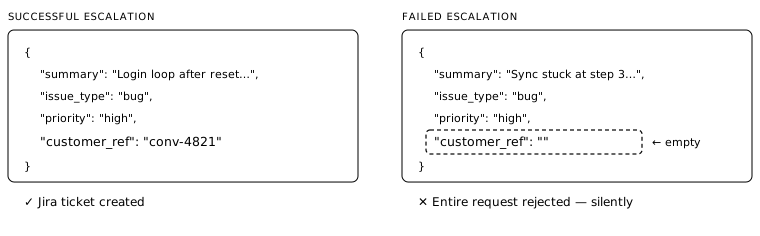
FindingA required attribute arriving empty. Jira rejects the entire request rather than accepting partial data.
05 — Root cause confirmed
Required attributes arriving empty or missing, and fields mismatching the Jira schema. Either condition prevents ticket creation, silently.
The elimination order mattered. Ruling out the connection first meant the problem was in what was being sent, not how it travelled. The rollback testing was investigative, not corrective: I progressively reverted the recent workflow modifications, testing after each step. When the failure stopped occurring, I knew the problematic change lived in the portion most recently reverted, without yet knowing what about it was wrong. The workflow’s structure wasn’t the cause; something in that change’s data handling was. Comparing successful and failed payloads line by line found it: a required attribute arriving empty in the failed requests, present in every successful one.
Escalation decision
I deliberately did not escalate to engineering immediately, but that never meant sitting on a known-broken path quietly. Containment started at once: support was working a temporary manual watch on escalated issues from the moment the signal was characterized. What I held back was the engineering hand-off, because reporting “escalations are failing” without understanding why would have handed engineering a mystery instead of a problem. I owned the investigation end to end: reproduction, comparison, rollback testing, payload inspection, root-cause validation, and the design of the operational fix. Once the cause was understood, I brought the findings to the lead software engineer for review, with reproduction steps, the successful-versus-failed comparison, workflow observations, and the payload evidence already packaged. His implementation involvement in this episode belonged to the separate attachment-synchronization work the migration case study describes. No customer communication was needed. The failure was internal to the escalation path, and support’s manual watch covered affected issues in the meantime.
Root cause
Jira rejected any request that violated its schema: a required attribute arriving empty or missing, or a field mismatching the expected schema. Because the rejection happened only on Jira’s side, Intercom appeared to succeed while no ticket was created.
Both systems behaved according to their own rules. Intercom sent what the workflow produced, Jira rejected what failed validation, and nothing surfaced the rejection where support was looking. The failure lived in the gap between the two systems rather than inside either platform individually, and the recent workflow modifications had widened that gap without anyone seeing it.
Engineering takeaway
When integrating systems, compare successful and failed payloads before debugging the transport. A single required field can cause the receiver to reject an otherwise valid request while the sender reports success.
Resolution
I designed the fix so that a bad payload would be caught before it ever left, and a recurrence would announce itself: I made the required attributes mandatory at the source, aligned the fields between Intercom and Jira, and added validation before escalation so a bad payload never left. I added error handling that produced a visible note inside the Intercom conversation, so the failure surfaced exactly where the person who owned the customer relationship was already looking, and a notification path so a failed escalation could no longer pass unseen. Additional testing followed, and validation continued over the following days as the rollout progressed.
What the team was told
Communication ran internally on two tracks while the investigation was open:
Representative reconstruction. Based on the operational workflow. Messages are reconstructed rather than reproduced verbatim.
- Holding message01
"The escalation workflow is under investigation. Some escalations may not be reaching Jira. Until it's confirmed reliable, keep temporary manual watch on escalated issues and flag anything that seems unanswered."
- Engineering update02
"Engineering hand-off: the failure reproduces, steps attached. Failed payloads differ from successful ones by a required attribute arriving empty; Jira appears to reject the whole request. Workflow observations and suspected root cause included."
- Resolution03
"The workflow has been validated. Escalations are creating tickets reliably, and failures now surface visibly. Normal escalation procedures resume."
What changed afterward
The durable change was observability. Before, the workflow could fail without anyone knowing. After, a failed escalation announced itself instead of disappearing. Validation moved ahead of escalation instead of relying on the receiving system’s silence. And the clearest signal that trust returned: once the workflow was reliable, the integration was expanded with additional attributes, because developers were willing to put more weight on a handoff they could now see.
Reflection
This investigation was not primarily about fixing a bug. It was about restoring observability. The failure’s defining property was that it produced no evidence anywhere the team could see. So the investigation’s real work was creating visibility: comparing successful and failed executions, narrowing the workflow through rollback testing, isolating differences, inspecting payloads, and validating one hypothesis at a time until the gap between two correctly-behaving systems became visible.
- This failure survived because it was silent and partial at once. A loud failure would have been fixed the day the workflow changed; this one produced healthy-looking automations and a subset of missing tickets, and cost accumulated until the absence itself became the signal.
- With no error message anywhere, every useful step of this investigation was a diff. Working escalations against broken ones, the current workflow against its rolled-back version, successful payloads against failed ones. The empty required attribute only became visible as a difference between two JSON bodies.
- Holding the engineering hand-off until I had a diagnosis shortened the whole incident. Engineering received reproduction steps, the payload comparison, and a suspected root cause in one package instead of a mystery to re-investigate from scratch, while support’s manual watch covered the gap.
- The part of the fix that outlived the bug was the visibility. Mandatory attributes closed this instance; validation-before-send and failures that announce themselves changed what any future instance will look like.
What this case demonstrates
Systems
- Intercom
- Jira
Outcome
- Root cause confirmed within roughly one working day
- Failures made to surface instead of hide
- Integration expanded once developers could trust the workflow
Continue reading
Case Study · 8 min read
Support Continuity During a HubSpot-to-Intercom Migration
FLiiP's support operation had outgrown its HubSpot-based helpdesk: routing, automation, and visibility limits were absorbing team time that should have gone to customers.
Engineering Note · 1 min read
The integration that rejects the whole request
Some systems reject an entire request over one invalid field, and from the sender's point of view it looks like nothing happened. Design for that before wiring any two systems together.